Will My Cat Forgive Me for Putting Her to Sleep?
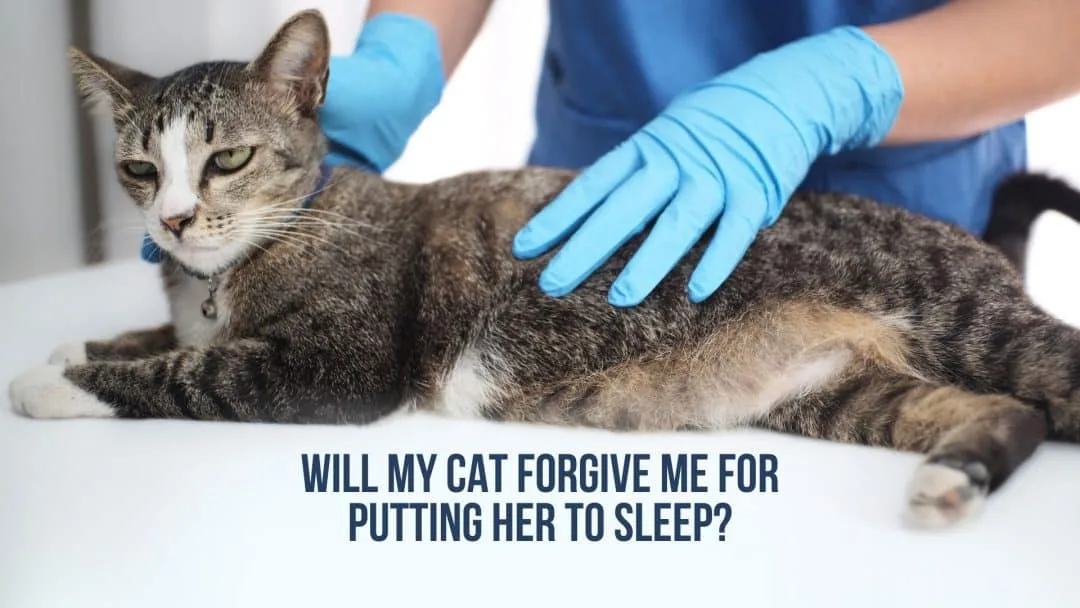
Will my cat forgive me for putting her to sleep? If you're asking that, you're likely sitting with a heavy, complicated guilt. The short answer might surprise you.
Your cat doesn't experience forgiveness the way we do.
But here's what the research actually says. According to the American Veterinary Medical Association's euthanasia guidelines, the procedure is designed to end suffering. Your cat's brain processes moments as they happen, not as part of a narrative.
As of 2026, no veterinary behavior studies suggest cats can perceive euthanasia as a betrayal. The weight you're carrying belongs to you, not your cat. Let's walk through what really happened and how to find peace.
Quick Answer
No, your cat does not need to forgive you. Cats cannot connect euthanasia to blame or betrayal. Your cat felt relief from pain and fear.
That relief was your final gift. The guilt you carry is human grief, not feline rejection. You made a compassionate decision based on love.
Why This Question Hurts — and What You're Really Asking
This question is rarely about your cat. It's about you. When you ask "will my cat forgive me," you're really asking if you did the right thing.
If you deserve peace again after making the hardest decision a pet owner can face.
The pain behind this question affects most people. Research from veterinary psychology suggests 60 to 80 percent of pet owners experience significant guilt after euthanasia. That's normal.
That's human. You are not broken for feeling this way. Guilt is a natural part of grief, not a sign you made the wrong call.
Anthropomorphism is the real trap here. We love our cats so deeply that we give them human emotions. We assume they feel forgiveness, resentment, and betrayal the way we do.
But feline brains don't work that way. Cats live almost entirely in the present moment. They don't build narratives around past events or assign moral blame.
A cat suffering from terminal illness doesn't think "my human should have done this sooner." They just feel pain. Then they feel relief.
The real question underneath is simpler and harder. It's "can I forgive myself?" That's the work you actually need to do. Your cat has already moved past suffering.
Now you need to move past guilt. And that starts with understanding what your cat actually experienced versus what you fear they experienced.
The guilt often splits into two camps. Some people worry they acted too soon. Others fear they waited too long.
Either way, you're second-guessing a decision made with love. The very fact that you're asking this question proves you cared deeply. People who don't love their cats don't lie awake wondering about forgiveness.
The bond you shared with your cat is exactly why this hurts so much. That bond doesn't end with death. It transforms.
Guilt is just love twisted by grief. When you untwist it, you find the same devotion that led you to make this choice in the first place. Your cat knew that devotion every single day.
What Cats Actually Understand About Death and Euthanasia
This might be the most important section for you to read. Let's talk about what's actually happening inside your cat's brain.
Cats have a different relationship with time and memory than humans do. Their short-term memory lasts about 16 hours. After that, specific events fade unless reinforced repeatedly.
Your cat's final moments are not stored as a traumatic memory to be replayed. They simply are not.
Feline cognition researchers at institutions like Cornell University's College of Veterinary Medicine have studied how cats process pain and relief. The findings are clear. Cats experience the world through sensory input.
They register pain, comfort, fear, and safety. They do not construct moral narratives about who caused what. Your cat did not lie there thinking "my human is doing this to me." Your cat felt you nearby, heard your voice, and experienced comfort from your presence.
The euthanasia process itself is designed with this in mind. A sedative is given first. Your cat becomes drowsy and relaxed before anything else happens.
Pain fades. Anxiety fades. Your cat drifts into a peaceful state.
The final injection happens after your cat is already deeply unconscious.
Image source: Bing (Web (fair-use with source credit))
What your cat experienced in those final moments was you. Your scent. Your voice.
Your touch. Not betrayal. Not fear.
Just the person they trusted most being there as the pain finally stopped.
The AVMA's guidelines on euthanasia emphasize that proper sedation ensures the animal experiences no distress. Your veterinarian followed protocols designed specifically to prevent suffering. That protocol is your ally, not something that worked against your cat.
You need to hear this clearly. Your cat did not experience euthanasia as punishment or abandonment. They experienced it as the end of suffering while held by someone they loved.
That is not something to forgive. That is something to thank yourself for.
The Real Pain Point: "Did I Do It Too Soon?"
This is the version of guilt that hits hardest. You wonder if there was more time. If you gave up too early.
If your cat still had good days left.
Let's look at this honestly.
Quality of life assessments are the standard tool veterinarians use to guide this decision. The HHHHHMM scale is one common framework. It looks at seven factors.
Hurt, Hunger, Hydration, Hygiene, Happiness, Mobility, and More good days than bad. Each factor gets a score. When the total drops below a certain threshold, euthanasia is the kind choice.
But you don't need a scoring sheet to know what you saw. You watched your cat hide more. Stop eating.
Struggle to reach the litter box. Flinch when touched. Sleep in positions that suggested pain.
You saw the life drain out of their eyes.
The fear of acting too soon is almost always balanced against the very real risk of waiting too long. Studies from veterinary palliative care show that most owners actually wait longer than they should. They want one more good day.
They hope for a miracle. They delay until the cat is in crisis.
Ask yourself this. Would you rather your cat had one less good day or one more bad day? One less good day means they left before they suffered further.
One more bad day means they endured pain you could have prevented.
There is no perfect answer. But here's a truth that might help. Cats are masters at hiding pain.
By the time you're certain they're suffering, they've been suffering for a while. Your decision was probably not too soon. It was likely right on time.
The veterinarian who performed the procedure witnessed your cat's condition. They agreed with your choice. That matters.
Veterinarians take euthanasia seriously. They will not perform it without medical justification. You had that justification.
Your Cat's Last Moments — What They Felt vs. What You Fear
Your imagination is probably filling in details that never happened. Let's replace those imagined horrors with facts.
The procedure follows a reliable sequence. Your cat receives a sedative injection. This takes effect within minutes.
Your cat becomes sleepy, relaxed, and comfortable. Their muscles loosen. Their breathing slows.
They may purr or knead if they're comfortable enough. Some cats fall asleep completely before the final injection.
The final medication is a barbiturate overdose. It stops the heart gently and quickly. Your cat does not feel it.
They are already unconscious when it enters their bloodstream. Breathing stops. The heart stops.
It takes seconds.
Here's what your cat felt during that process. Warmth from your hands. The sound of your voice.
Familiar scent. Decreasing pain. Increasing drowsiness.
Then nothing.
Here's what your cat did not feel. Fear of death. Awareness of what was happening.
Resentment toward you. Pain from the final injection. Regret.
Cats don't have a concept of their own mortality. They don't know what death means. They only know that they hurt, then they didn't.
The fear you're carrying is your human brain trying to make sense of something that doesn't make sense. Death is inherently senseless to the living. Your cat did not experience that confusion.
They just experienced you being there as the pain stopped.
Many people worry about whether their cat looked at them with accusation. What you likely saw was a cat in a relaxed, sedated state. Heavy eyes.
Soft expression. Maybe a slow blink. That slow blink is a cat's way of saying "I trust you." Not "I hate you." Your cat trusted you until the very end.
How to Start Forgiving Yourself — Steps That Actually Help
Forgiveness doesn't come from a single realization. It comes from repeated small actions over time. Here are steps that actually work.
First, stop revisiting the decision. You made it. It's done.
The cat is no longer suffering. Replaying the moment will not change the outcome. Every time you catch yourself asking "what if," gently redirect to "I did what I could with what I knew." That's the truth.
Write a letter to your cat. Describe the decision. Explain why you made it.
List the signs of suffering you saw. Tell them you loved them. Then read it aloud.
This sounds strange, but it works. It moves the guilt from your chest to the page where you can see it clearly.
Talk to someone who gets it. Pet loss support groups exist in most communities. The Association for Pet Loss and Bereavement offers resources and hotlines.
You don't need to explain yourself. These people understand. They've been where you are.
Create a small ritual to honor your cat. Light a candle on the anniversary. Plant something in their memory.
Keep a photo in a special place. Rituals give grief a container. Without a container, grief spreads everywhere and feels overwhelming.
Separate guilt from grief. Guilt says "I did something wrong." Grief says "I miss them." They feel similar but they are not the same. When you feel that tightness in your chest, ask yourself which one it is.
Most of the time, it's grief wearing a guilt costume.
Veterinary behaviorists confirm that the act of euthanasia is one of the most selfless choices a pet owner can make. You absorbed your cat's suffering so they didn't have to carry it anymore. That is not a betrayal.
That is the final act of love.
Finally, consider this. Your cat never once thought about whether you would forgive them. They just loved you.
They loved you on the good days and the bad days. They loved you when you were late with dinner and when you cried into their fur. That love didn't stop when their heart did.
It's still there. You just have to find it underneath the grief.

Similar Posts