7 Subtle Signs Your New Cat Is Adjusting
You've brought your new cat home. The carrier door opens, and then… nothing. They bolt under the couch, and you're left staring at an empty room wondering if you've made a huge mistake.
Take a breath. This is exactly what "signs your new cat is adjusting" looks like in the early days, and it's almost never a reflection of you or your home. Cats are creatures of habit, and you've just turned their entire world sideways.
The good news? Most cats come around within a week or two if you read their signals and resist the urge to force things. It's a process, not a race.
In our research, the widely accepted benchmark in feline behavior circles is the "3-3-3 rule": three days to decompress, three weeks to settle into a routine, and three months to feel truly bonded. As of 2026, veterinary behaviorists still lean on this framework because it tracks with how cats actually process new environments, both physiologically and emotionally. The key is understanding which stage your cat is in right now and what their current behavior is telling you.
Image source: Bing (Web (fair-use with source credit))
Quick Answer
Your new cat is adjusting when they start eating normally, using the litter box, and showing relaxed body language. The adjustment period typically spans a few days to several weeks. Hiding at first is completely normal.
Look for slow blinks, a raised tail, and curiosity about you and the room.
Why the First 3-3-3 Rule Matters Most
The 3-3-3 rule isn't just a catchy phrase vets throw around. It's a practical timeline that prevents you from panicking on day two when your cat is still camped out behind the toilet. Understanding the stages gives you a baseline.
Without a baseline, you'll either overreact to normal behavior or miss the signs that something's actually wrong.
Phase one: Decompression (Days 1-3).
Your cat's nervous system is running on high alert during the first few days. They've been taken from everything familiar, and their survival instinct is screaming "new place, new smells, predators." This is when you'll see the most hiding, the most hissing, and the most refusal to come out during the day. It's not personal, it's instinct.
Phase two: Settling in (Days 4-21).
Once your cat realizes the food bowl keeps refilling and the giant creature walking around isn't a threat, they start exploring. This is when you'll notice them venturing out more, claiming favorite spots, and maybe even gracing you with a head bump or two. The litter box habit should be solid by now, and their appetite should feel predictable.
Phase three: Bonding (Weeks 5-12).
This is when the real relationship clicks. Your cat lets their guard down completely. They sleep in the open, seek out your lap, and initiate play.
This is where the "forever bond" forms, and it's also where the truly subtle trust signals start showing up. It takes patience to get here, but every rescued shelter cat I've worked with has followed this arc once given the space.
Condition Check: Decoding Where Your Cat Is Right Now
Before you can figure out what your cat's behavior means, you need to read the room. Or rather, read the cat. Three core signals give you 90% of the information: eating patterns, litter box usage, and body language.
Everything else, the meowing and scratching and sleeping, builds on these three foundations.
You're looking for trends, not single events. A cat who skips dinner on night one but eats breakfast on day two is adjusting fine. A cat who won't touch food for 48 hours is a different story entirely.
The same logic applies to the litter box. One accident by the door on day two is a sign of disorientation. Three accidents in the same corner by week two means you have a different problem on your hands.
Body language is where most new owners get lost. Keep it simple at first: relaxed ears, slow blinks, and a tail that stands straight up with a slight curve at the tip are all good signs. A hunched posture, flattened ears, and a tail tucked between the legs mean your cat feels threatened.
In the early days, assume they're scared until proven otherwise. That mindset keeps you from moving too fast.
Decision Branch 1: Hiding Hard (Days 1-7)
Here's the scene: it's day three, and your cat has only emerged at 2:00 AM to eat and use the box. You're not the only one who's been through this. I've been there, and pretty much anyone who's ever brought home a new cat has lived a version of this same anxious reality.
It says a lot about how things are going that they're eating and using the box at all, even if you never see them do it.
If your cat is hiding but still eating and using the litter box at night, that's a green light.
Their instinct to hide is strong, but hunger and a full bladder are stronger. It means they trust the environment enough to take care of their basic needs. Your job is to let them have their hiding spots without pestering them.
Let them have the dark corner under the bed. The fastest way to slow this process down is by crawling in after them with a towel.
If your cat hasn't eaten in 24 hours and won't come out even for food, that's a yellow light.
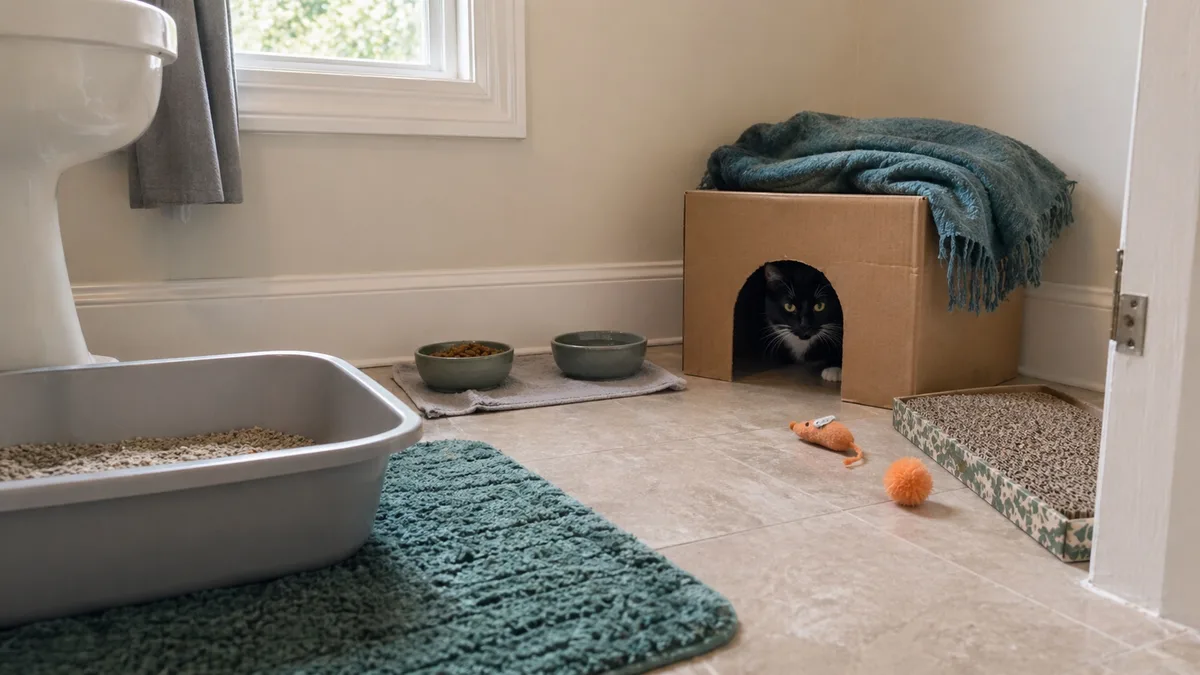
Start by placing food and water right at the edge of their hiding spot, not out in the open. Add a litter box nearby too. You want to create a small "safe zone" that minimizes their need to venture out into the open before they're ready.
If they still won't eat by 48 hours, it's time to call your vet for advice, since cats can develop serious health issues like hepatic lipidosis from going too long without food.
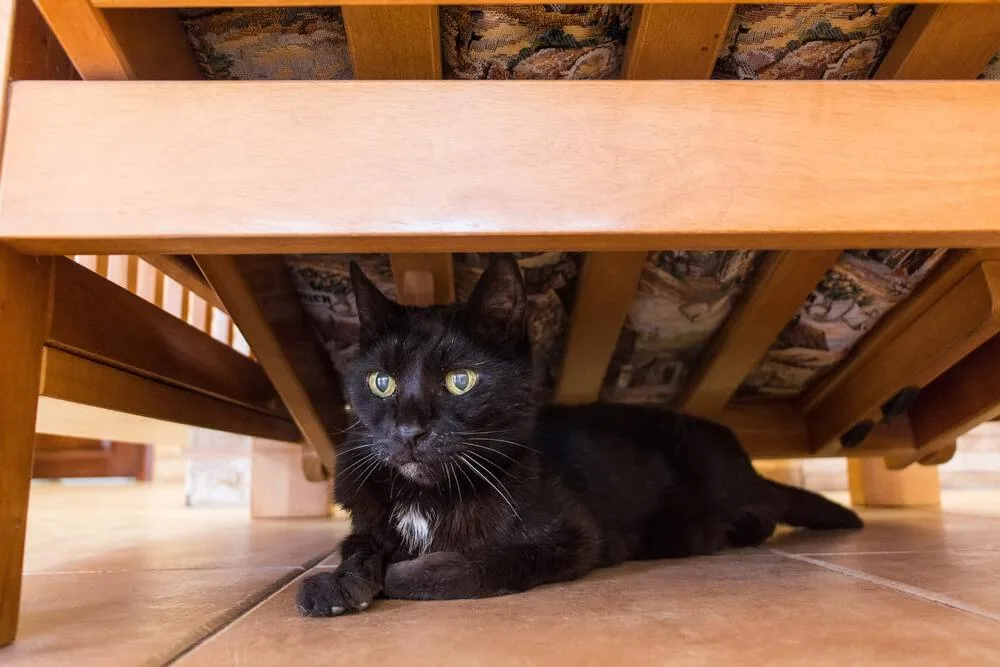
Image source: Bing (Web (fair-use with source credit))
Decision Branch 2: Eating and Drinking Patterns
Food is the clearest early indicator of how a new cat is settling in. When a cat's stress levels spike, their appetite usually tanks first. If you see your cat chowing down right away, that's a fantastic sign.
It means they've decided the environment is safe enough to let their guard down slightly. Conversely, a cat holding out for days is telling you they're still in survival mode.
The 24-hour rule is your first benchmark.
If a healthy adult cat hasn't eaten anything within 24 hours of arriving home, you need to step in. Silently and calmly, place a small dish of food directly near their hiding spot, sit a few feet away, and just exist. No reaching, no talking, no eye contact.
Let the food smell work its magic while you prove you're not a threat. Many cats will tentatively take a bite once they see you're not focused entirely on them.
Kittens have a much shorter fuse than adults.
A kitten under six months old starts at risk of hypoglycemia much faster if they refuse food. If you've got a kitten who's skipped meals for more than 12 hours, that's worth a call to your vet. Their small bodies burn through energy reserves rapidly.
Try warming their wet food for a few seconds in the microwave, since the smell is stronger and signals "fresh food" to a nervous brain.
Decision Branch 3: Litter Box Behavior as a Trust Signal
If you want the single most revealing sign of how your new cat is adjusting, watch the litter box. A cat who's using the litter box regularly is a cat who feels secure enough to have a routine. It's one of the first habits to return once their stress settles, and it's also one of the first to break when they're overwhelmed.
The box works like a barometer for their anxiety level.
Expect a learning curve in the first few days.
Your new cat has just been through a whirlwind of carrier rides, vet checkups, and a brand-new home. They might not know exactly where the box is, or they might be too nervous to walk across the room to use it. Place the litter box in a quiet, low-traffic corner, away from their food and water bowls.
This is a non-negotiable setup. Cats do not like to eat where they do their business, and they definitely don't want to be caught in the open while using the restroom.
One accident outside the box is common, but pay attention to patterns.
If they miss the box on day one, clean it up thoroughly and don't make a big deal about it. Rubbing their nose in it or raising your voice only makes them associate the location with a scary event, which will make the accidents worse. If you see them circling and scratching at the floor, gently pick them up and place them in the box.
If they seem confused about what to do when they get there, it's okay to give them a second to figure it out on their own. Per the American Veterinary Medical Association (avma.org), sudden changes in litter box habits after the first few days could signal a urinary tract issue, so if you notice straining, bloody urine, or frequent crying in the box, that's a clear call to your vet.

Similar Posts