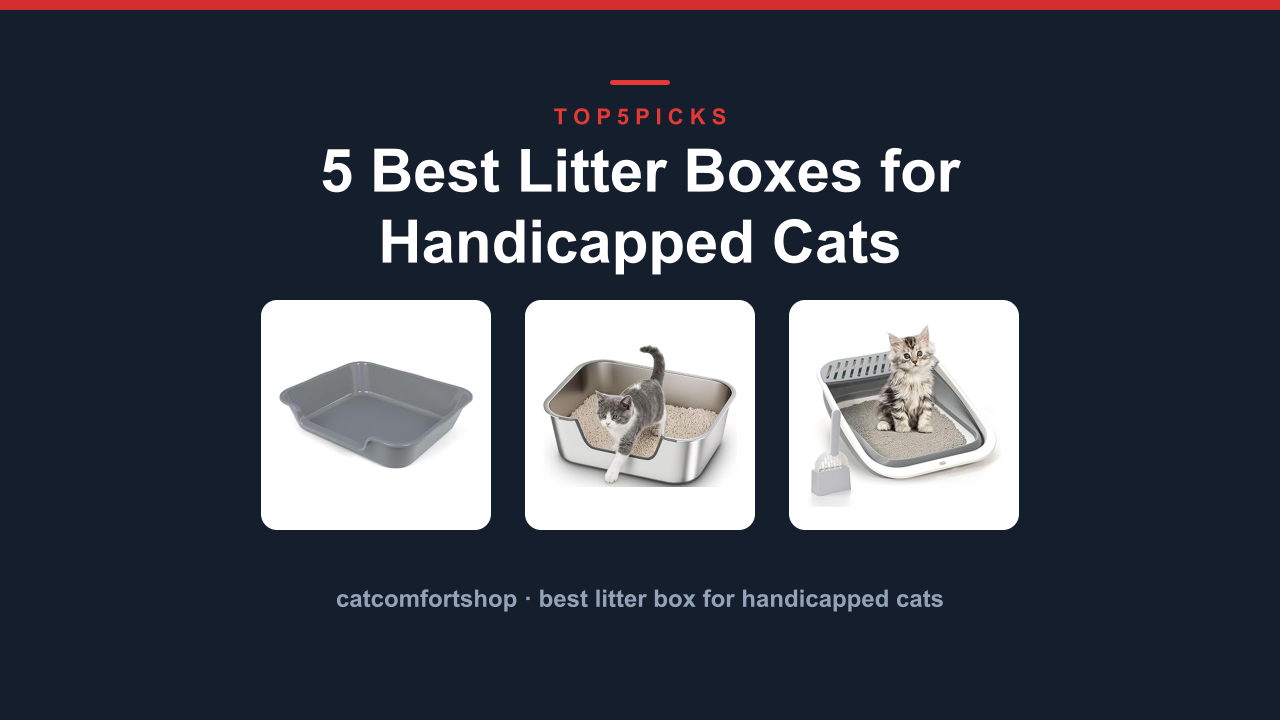
5 Best Litter Boxes for Handicapped Cats
The best best litter box for handicapped cats is the 1 Extra Large Cat Litter Box, the only one here that pairs a jumbo 24-inch by 20-inch footprint with a low 4-inch entry wall. This combination gives a senior or mobility-impaired cat enough room to turn around without squeezing over a high lip.
Want a material that won't absorb odors over time instead? The Qiuma Stainless Steel Cat Litter Box gets you there, as long as your cat is small to medium and you don't need a huge pan.
As an Amazon Associate, I earn from qualifying purchases.
Most advice lumps "low entry" with "small," which is exactly wrong for a handicapped cat that needs room to brace. This guide tells you which boxes actually give both, and it names the buyers who should skip this category entirely.
Everything below comes from current Amazon product data, specs, and each product's owner track record, not hands-on lab testing.
Quick Answer: The Best Litter Box for Handicapped Cats
The 1 Extra Large Cat Litter Box leads this list because its jumbo ABS pan combines a shallow step-in height with enough floor space for an arthritic or post-surgery cat to maneuver.
- 1 Extra Large Cat Litter Box (Best Overall for Senior Cats): Jumbo ABS pan with a low 4-inch entry wall and room to turn.
- Qiuma Stainless Steel Cat Litter Box (Best Odor Control for Small Cats): Stainless steel pan that resists scratches and odor trapping.
- Foldable Cat Litter Box (Best for Travel/Storage): Height-adjustable sides that collapse flat when not in use.
- Extra Large Litter Box Low Entry (Best Open Corner Design): Corners-fit layout with a 5.9-inch low wall and generous 23.6-inch length.
- Extra Large Cat Litter Box High (Best Anti-Splash for Active Diggers): Same low entry as #4 but with higher sides to contain kicked litter.
Thinking about a hooded box or an automatic self-cleaning unit instead? Jump to Who Should NOT Buy below before you spend anything.
Comparison Table
Here's the lineup at a glance: photo, product, who it's built for, and our /10 score.
| Photo | Product | Best for | Score | Buy |
|---|---|---|---|---|
 | 1 Extra Large Cat Litter Box | Jumbo Space for Senior Cats | 9.1/10 | Check price → |
 | Qiuma Stainless Steel Cat Litter Box | Odor-Free Hygiene for Small Cats | 8.5/10 | Check price → |
 | Foldable Cat Litter Box | Adjustable Height & Collapsible Storage | 7.9/10 | Check price → |
 | Extra Large Litter Box Low Entry | Corner-Friendly Spacious Pan | 8.0/10 | Check price → |
 | Extra Large Cat Litter Box High | Anti-Splash Litter Protection | 7.8/10 | Check price → |
Scroll sideways on small screens to see every column.
1 Extra Large Cat Litter Box:
Qiuma Stainless Steel Cat Litter Box:
Foldable Cat Litter Box:
Extra Large Litter Box Low Entry:
Extra Large Cat Litter Box High:
Buying Guide: Entry Height, Floor Space, Material and Stability
Picking a litter box for a handicapped cat comes down to four factors. Get these right and your cat will use the box consistently. Get them wrong and you will be cleaning accidents off your floor.
What entry height does your cat actually need?
The entry wall is the single most important measurement for a cat with mobility problems. A standard litter box has a 6-to-8-inch front wall that a healthy cat hops over without thinking. For a cat with arthritis, hip dysplasia, or hind-leg weakness, that height becomes a barrier.
The boxes on this list range from about 4 inches to 5.9 inches at the front. That difference matters. A 4-inch entry, like the one on the 1 Extra Large Cat Litter Box, works for most senior cats.
A 5.9-inch entry, like on the Extra Large Litter Box Low Entry, is still lower than standard but might be too high for a cat that drags its back legs.
Measure your cat's leg length from the floor to the elbow. If the entry wall is higher than that measurement, your cat will struggle.
How much floor space does a handicapped cat need?
A cat with limited mobility needs room to turn around inside the box without bumping into the walls. If the box is too narrow, your cat may eliminate outside the pan or avoid using it altogether.
The smallest box here, the Qiuma at 17.5 by 13.6 inches, is fine for a small cat. The largest, the 1 Extra Large at 24 by 20 inches, gives a full-grown cat room to pivot. As a rule of thumb, the box should be at least 1.5 times your cat's body length from nose to tail base.
Plastic vs. stainless steel: which lasts longer?
Plastic pans are lighter and cheaper, but they absorb odors over time. ABS plastic, used in our top pick, resists odor better than standard polypropylene because it is denser and less porous. Stainless steel, as seen in the Qiuma pan, is non-porous and will never hold smells, but it costs more and is heavier.
If you have a cat with chronic kidney disease or diabetes, whose urine has a stronger odor, stainless steel is worth the investment. For a cat that is otherwise healthy, a quality ABS pan will serve you well for years.
Does stability matter for a wobbly cat?
Cats with neurological conditions or muscle weakness may lean against the sides of the box while they eliminate. A flimsy pan that flexes under that pressure can startle your cat and make them associate the box with discomfort.
The thicker the plastic, the more stable the box. The 1 Extra Large Cat Litter Box uses ABS that stays rigid. The polypropylene models, especially the foldable one, flex noticeably under weight.
If your cat wobbles or leans while using the box, choose the stiffest pan you can find.
Who Should NOT Buy Best Litter Box for Handicapped Cats
This category of low-entry open pans is the wrong purchase for a few kinds of buyers. Here is who they are and what to look at instead.
You Need a Fully Enclosed or Hooded Box
If your cat is used to the privacy of a covered box or you need to contain strong odors inside the unit, an open pan will not work. Low-entry boxes are open by design, so smells travel freely into the room.
Look at a top-entry litter box instead. These have a lid with a hole on top, which keeps odors inside and prevents the cat from backing out mid-use. Many top-entry models also have low interior walls, so your cat can stand comfortably once inside.
Your Cat Has Severe Hind-End Paralysis
A cat that drags both back legs or cannot support its own weight to squat will struggle with even a 4-inch entry wall. No standard pan on this list solves that problem.
You need a very shallow tray or pan, ideally one with walls under 2 inches. Some owners repurpose large under-bed storage bins and cut one side down to ground level. Others use disposable aluminum roasting pans as a temporary solution.
For a permanent setup, look for a "pans for paralyzed cats" product designed with a ramped or flush entry.
You Want a Self-Cleaning Automatic Box
If your goal is to reduce daily scooping, none of these manual pans will meet that need. Automatic self-cleaning litter boxes use rakes or rotating drums to sift waste into a sealed compartment.
The trade-off is that most automatic models have higher entry walls and complex mechanisms that can confuse or frighten a handicapped cat. If you go that route, look for an automatic model specifically rated for senior or disabled cats, with a low step-in height and a gentle cycle.
Final Verdict
The 1 Extra Large Cat Litter Box is our top pick because it combines the lowest entry wall in this lineup with the largest floor area, all in a rigid ABS pan that will not flex under your cat's weight. For a senior or disabled cat, that combination is hard to beat.
Want a pan that will never hold urine odor no matter how many years you use it? The Qiuma Stainless Steel Cat Litter Box is the right choice, as long as your cat is on the smaller side.
Need something that folds flat for travel or storage? The Foldable Cat Litter Box gives you adjustable height and collapsible design at a budget-friendly price.
If your cat kicks litter everywhere, the Extra Large Cat Litter Box High adds splash protection while keeping the front entry low. And if you need a corner-friendly shape, the Extra Large Litter Box Low Entry fits neatly against two walls.
Before you buy, think about whether your cat's mobility challenges go beyond what a low-entry pan can solve. If your cat drags its back legs or cannot stand at all, jump up to the Who Should NOT Buy section for alternatives that actually address that need.
FAQ
What is the best litter box for handicapped cats overall?
The 1 Extra Large Cat Litter Box is the best overall option because it offers a jumbo 24-inch by 20-inch footprint with a low 4-inch entry wall, all in rigid ABS plastic that resists odors and stays stable under heavy cats.
What entry height should I look for in a litter box for a disabled cat?
Aim for an entry wall of 4 inches or less. Standard boxes often have 6-to-8-inch walls that are too high for cats with arthritis, hip pain, or hind-leg weakness. Measure your cat's leg height from floor to elbow to confirm.
Can I use a stainless steel litter box for a handicapped cat?
Yes. Stainless steel pans like the Qiuma model are non-porous and will not absorb urine odors, making them easier to keep hygienic. Just make sure the pan is large enough for your cat to turn around and the entry wall is low enough for easy access.
Is a foldable litter box sturdy enough for a disabled cat?
A foldable box works well for travel or occasional use, but it is less rigid than a solid ABS or stainless steel pan. The folding seams can trap moisture, and the plastic walls flex more under weight. It is best for cats that do not lean heavily on the sides.
How often should I clean a litter box for a handicapped cat?
Scoop at least once daily, and do a full dump-and-wash every one to two weeks. Handicapped cats are more prone to urinary tract infections, so keeping the box clean reduces the risk of your cat avoiding it and holding urine too long.
What if my cat refuses to use the new low-entry box?
Place the new box next to the old one for a few days so your cat can explore it without pressure. Use the same litter type initially. If your cat still hesitates, try adding a small towel or yoga mat in front of the entry to give them better footing when stepping in.